Category: PC Hardware

  • Do You Really Need a $1,000+ PC for a Great Gaming Experience?

    Do You Really Need a $1,000+ PC for a Great Gaming Experience?

    No. And the sooner the gaming industry stops implying otherwise, the better.

    The real answer to this question starts with one question back at you: what do you actually play? Because the hardware you need for Valorant, PUBG Mobile on emulator, and Minecraft is completely different from what you need for Cyberpunk 2077 at 4K with ray tracing. Treating them the same is where the confusion and the overspending begins.

    The Myth That’s Costing People Real Money

    The idea that great gaming requires expensive hardware is one of the most successfully marketed myths in consumer technology. It feeds on comparison anxiety you see someone’s $2,000 battlestation on YouTube and assume that’s the entry price. It isn’t.

    A well-optimised $500 gaming PC can deliver impressive results, especially in esports titles. Valorant runs at extremely high frame rates, often exceeding 100 FPS even on high settings. Fortnite runs at smooth 60-70 FPS on competitive settings. Apex Legends is fully playable with balanced settings.

    If you play esports titles, a $500 machine is not a compromise. It’s genuinely the right tool for the job.

    The Specification Problem Nobody Explains

    Here is the thing manufacturers never tell you clearly: the minimum and recommended specs printed on a game’s store page apply only to that game running completely alone on a clean system.

    They do not account for:

    Windows itself consuming 3-5GB of RAM before you open a single app. That overhead is not optional it is the operating system doing its job, and it runs whether you want it to or not.

    Background processes you forgot were running including Discord, your browser, Steam client, Xbox Game Bar, OneDrive sync, antivirus scanner, and Windows Update downloading silently while you play.

    This is why a PC that technically meets “recommended” specs still stutters. The developer tested on a clean machine with nothing else running. Your machine is never clean. 16GB of RAM is the floor you may need to close unnecessary applications when playing resource-intensive games because Windows, a game launcher, and the game itself together are already pushing against that ceiling.

    The practical rule: always mentally add 4-6GB to any RAM requirement you read on a game’s store page. A game listed as needing 8GB actually needs 12-14GB in real-world conditions when Windows and your background apps are factored in.

    The Confusion That Sends People Overspending

    Most people approach hardware buying backwards. They look at the most demanding game they might ever want to play, find the recommended spec for that game, and build to that number. Then they pay for hardware they use at 20% capacity for 90% of their gaming sessions.

    The better question is: what is the ceiling of what you actually play today?

    If you are planning on mostly playing 2D indie games or esports games such as League of Legends and Valorant, you likely will not need a super-powerful machine since these titles are usually well-optimised to run on lower-end hardware.

    Here is the honest breakdown of what different types of players actually need:

    What You PlayReal Example GamesBudget NeededGPU Sweet SpotWhat to Skip
    Esports & Light GamesValorant, CS2, Roblox, PUBG Mobile emulator$400 – $500No GPU needed, integrated graphics worksDedicated GPU, RTX anything
    Popular Battle RoyaleFortnite, Apex Legends, Warzone (1080p)$500 – $700RX 6600 or RTX 3060Anything more powerful than these two
    Open World AAA (1080p 60FPS)GTA V, Cyberpunk, Hogwarts Legacy$600 – $800RTX 3060 Ti or RX 6700Expensive CPU, premium motherboard
    AAA at 1440pCyberpunk, Alan Wake 2, Black Myth$900 – $1,100RTX 4070 or RX 7800 XTFlagship GPU, extreme speed DDR5
    4K Max Settings Ray TracingEverything at absolute best visuals$2,000+RTX 4090 or RTX 5080Most people genuinely do not need this tier

    The last row in that table is where $1,000+ becomes relevant. Everything above it does not need it.

    The Hardware Myths That Drive Bad Purchases

    More cores means better gaming.

    It does not. Most modern games still rely heavily on strong single-thread performance and efficient scheduling rather than simply throwing more cores at the problem. That is why CPUs with fewer, faster cores often outperform chips with larger core counts in gaming workloads. Buying a 16-core CPU for gaming means paying for 10 cores that will sit idle during your entire session.

    You need an expensive motherboard for good performance.

    You do not. Budget and midrange CPUs run perfectly fine on mainstream boards. Unless you are chasing extreme overclocks, spending extra purely for a premium motherboard is money that could be better allocated elsewhere. A B650 or B760 board does everything a gaming PC needs.

    Future-proofing justifies spending more today.

    Future-proofing is a myth that hardware companies love. No amount of spending today prevents your build from being mid-range in 3-4 years. Instead of overspending now, build smart at mid-range and use the savings for a GPU upgrade in 2-3 years. The money you save buying appropriately today will buy you a better upgrade in two years than the premium you paid today ever justifies.

    The most expensive version of a component is the safest choice.

    The best build is not the one that spends the most it is the one that aligns with how you actually play. Performance is not just measured in frames.

    The Free Fixes Nobody Tries First

    Before spending a single dollar on hardware, do these things. Most people skip straight to buying parts without ever doing the free version first.

    Close Chrome before launching your game. Chrome holds 500MB-1GB of RAM open even with zero tabs visible. That memory comes directly out of what your game can use.

    Turn Xbox Game Bar off. Go to Settings, Gaming, Xbox Game Bar, and switch it off. It runs constantly, consumes CPU, adds input latency, and the vast majority of players never use it once.

    Set your Power Plan to High Performance. Windows defaults to Balanced mode on most systems, which throttles your CPU clock speed to save power including during gaming. Go to Control Panel, Power Options, and switch to High Performance. This is free and immediate.

    Pause Windows Update before gaming sessions. Windows Update downloads and installs silently in the background and competes directly with your game for CPU, RAM, and storage bandwidth. Pause it for 7 days in Settings, Windows Update, Advanced Options.

    Add your game folders to antivirus exclusions. Your antivirus scans every file write in real time during installation and gameplay. Adding your game library folder to Windows Defender exclusions stops this silent overhead completely.

    These five changes cost nothing and together deliver more real-world performance improvement than upgrading from 8GB to 16GB RAM would on many systems. Try them before you open PCPartPicker.

    The One Component Where Money Actually Matters

    If you are going to spend more anywhere, spend it on the GPU. Not the CPU, not the motherboard, not RGB lighting. The GPU.

    The GPU renders everything you see. For gaming, this is typically the most important component and where most of your budget should go.

    Everything else in a gaming PC exists to support the GPU doing its job. A fast CPU paired with a weak GPU produces a slow gaming machine. A modest CPU paired with a strong GPU produces a fast one. That hierarchy is consistent across almost every gaming workload that exists.

    Second priority is your monitor, not your PC components. A $700 PC driving a quality 1440p 144Hz monitor produces a better daily gaming experience than a $1,200 PC driving a 1080p 60Hz monitor that came free with a desk. Do not build a sports car and park it on a dirt road.

    The Honest Summary

    You do not need a $1,000+ PC for a great gaming experience. You need the right PC for the games you actually play.

    The best gaming PC in 2026 is the one that matches your needs, not just the highest spec sheet. Choose wisely and you will end up with a system that delivers great performance today and stays relevant for years to come.

    Start by answering what you play. Build to that ceiling. Do the free Windows optimisations first. Spend the GPU budget where it belongs. And stop measuring your gaming experience in dollars measure it in whether the game runs well for the way you actually play it.

    That is the only spec that matters.
  • SSD vs HDD

    SSD vs HDD

    Your computer stores everything on a drive Windows, your apps, your games, your files. The type of drive you have has a bigger impact on how fast your PC feels than almost anything else. Most people never think about it, but it’s the single most important factor in whether your computer feels fast or frustratingly slow every single day.

    There are two main types: the old HDD (Hard Disk Drive) and the newer SSD (Solid State Drive). Let’s break down exactly what they are, how different they actually are in real numbers, and what’s coming next.

    WHAT THEY ARE

    SSD – Solid State Drive

    An SSD has no moving parts at all. It works like a very large USB stick it stores and reads data using electronic chips. When you ask it for a file, it finds it almost instantly because there’s nothing physical that has to move. It makes no noise, it doesn’t vibrate, and dropping your laptop won’t destroy your data. This is what almost every new laptop and PC ships with today.

    HDD – Hard Disk Drive

    An HDD is a spinning magnetic disk, almost exactly like a vinyl record, with a tiny reading arm that has to physically swing across the disk to find your data. Every time you open a file, that arm has to locate it on the spinning disk. The faster the disk spins, the faster it can find things but it’s still mechanical, which means it has physical limits. It makes a quiet humming sound when running, and dropping it even slightly can damage or destroy all your data permanently.

    REAL PERFORMANCE NUMBERS GAMES AND SOFTWARE

    This is where the difference stops being abstract and starts being something you feel every single day.

    Windows Startup Time
    On an SSD, Windows starts up in about 8 to 12 seconds. On an HDD, the same Windows installation takes 45 to 90 seconds. That’s not a small difference you’re staring at a loading screen for over a minute every time you turn on your PC.

    Adobe Photoshop Launch Time
    Photoshop opens in roughly 4 seconds on an SSD. On an HDD, it takes 22 to 30 seconds to fully load. If you use creative software regularly, this adds up to many minutes of waiting every single work session.

    GTA V Loading Into the Game World
    On an SSD, you’re in the game in about 30 seconds. On an HDD, the same load takes 4 to 6 minutes. That’s not a typo. Players on HDDs were so well known for long load times that Rockstar Games actually released a patch specifically to speed up HDD loading after a modder discovered the game had inefficient code making it worse.

    Microsoft Excel Opening a Large 50MB File
    On an SSD, a large spreadsheet opens in about 2 seconds. On an HDD, the same file takes 12 to 18 seconds. For anyone doing data work or finance work, this kind of delay happens dozens of times a day.

    Call of Duty Warzone Map Loading Screen
    On an SSD, you’re into the match in about 25 seconds. On an HDD, loading takes 2 to 3 minutes and Warzone is known for actually kicking players with HDDs during loading because the game’s servers consider them too slow to keep up with other players. You don’t just wait longer. You get removed from the game entirely.

    Drive Read Speed How Fast Data Reaches Your Software
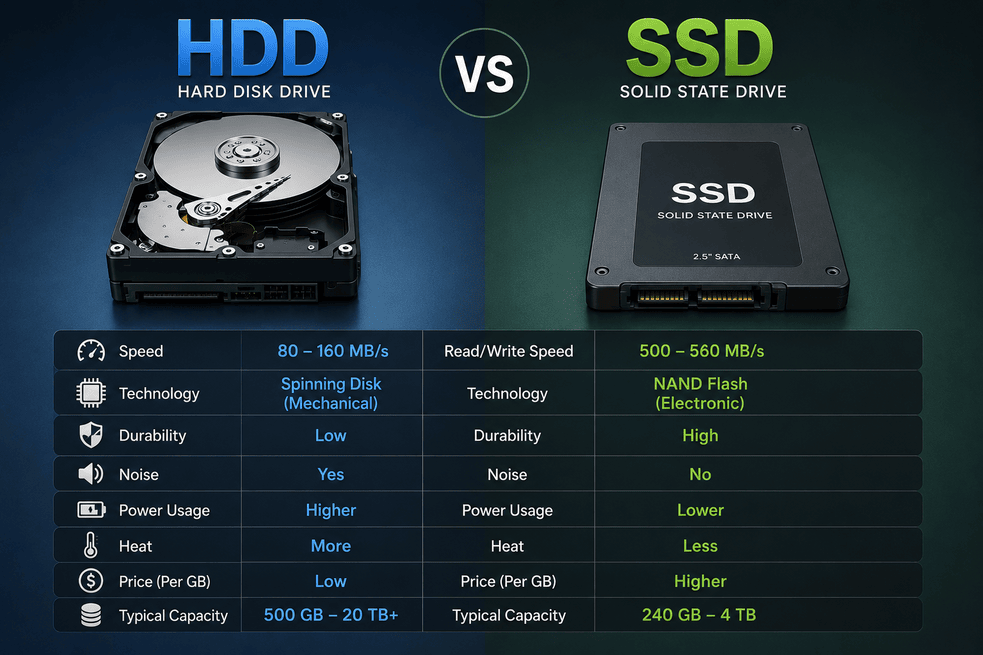
    This is the raw measurement of how quickly the drive can hand data to your software. An NVMe SSD (the fastest common type) reads at around 3,500 MB per second. A SATA SSD (older type) reads at around 550 MB per second. A standard HDD reads at 80 to 160 MB per second. Think of MB/s like lanes on a highway more lanes means more data delivered to your software at once, which means faster everything, across every app you use.

    QUESTIONS YOU PROBABLY HAVE

    Q: If SSD wins at everything, why do people still buy HDDs?

    Because of storage space per rupee or dollar. A 4TB HDD that’s 4,000 GB, enough for 40 or more big games costs around 60 to 70 percent less per gigabyte than an SSD of the same size. If you have hundreds of movies, years of photos, or archived work files you rarely open, it makes perfect financial sense to store all of that on a cheap HDD. Speed only matters when you actually open a file. Data sitting on a drive doing nothing doesn’t benefit from speed. So most smart setups use an SSD for Windows and active software, and an HDD for bulk storage.

    Q: Does the type of SSD matter? What is NVMe?

    Yes not all SSDs are equal, and this matters more than most people realize. SATA SSDs are the older type and plug in using the same cable as a regular hard drive. They’re faster than HDDs but limited by that older connection. NVMe SSDs plug directly into your motherboard through a dedicated slot and use a much faster connection. An NVMe SSD is about 6 times faster than a SATA SSD, and about 30 to 40 times faster than a standard HDD. If your PC or motherboard supports NVMe, always choose it for your main Windows drive.

    Q: Will an SSD make my old PC faster overall?

    Yes and it’s usually the single most impactful upgrade you can make to an aging computer. If your PC is slow to start, slow to open apps, or freezes up when you have several things open at once, there’s a very high chance the HDD is the main bottleneck, not the processor or RAM. Replacing the HDD with an SSD can make a 7-year-old computer feel 3 to 4 times more responsive for everyday use. Your RAM and processor still matter for heavier tasks like video rendering or gaming graphics, but a slow HDD drags down everything else first.

    Q: Can software actually fail or crash because of a slow HDD?

    Absolutely. This is becoming more common as software gets larger and more complex. Games like Cyberpunk 2077 and Fortnite now list an SSD as a minimum system requirement not a recommendation, but a requirement. On an HDD, textures fail to load in time, so you see blurry walls, invisible objects, or environments that pop into existence right in front of you mid-game. Warzone is the most famous example it actively removes players with HDDs from loading screens because the game treats their loading speed as a connection problem. This issue will only get worse as games and software grow larger.

    Q: Can software actually fail or crash because of a slow HDD?

    Absolutely. Games like Cyberpunk 2077 and Fortnite now list an SSD as a minimum system requirement not a suggestion. On an HDD, textures fail to load fast enough, so you see blurry walls, pop-in objects, or invisible enemies. Warzone is the most famous example it kicks HDD players during loading because the game interprets slow loading as a connection issue. This will only get worse as games grow larger and stream data in real-time during gameplay.

    HOW THEY COMPARE IN PRICE

    These are percentage comparisons, not exact prices, since prices vary by brand, capacity, and region. The key thing to understand is the relative value.

    HDD is the cheapest option and acts as the baseline.

    SATA SSD costs roughly 2 to 3 times more per gigabyte than an HDD of the same size.

    NVMe SSD costs roughly 3 to 4 times more per gigabyte than an HDD.

    NVMe Gen 5 SSD, the newest and fastest type, costs roughly 6 to 8 times more per gigabyte than an HDD.

    The good news is that SSD prices have dropped dramatically over the past 3 years. A solid 1TB NVMe SSD today costs roughly the same as a 1TB HDD cost back in 2018. The gap is closing fast, and for most people the price difference for a 1TB drive is no longer a huge barrier.

    NEW STORAGE TYPES ENTERING THE MARKET

    The storage industry is moving quickly. Here’s what’s arriving in mainstream PCs right now or in the next one to two years.

    NVMe Gen 5 SSD Available Now

    This doubles the speed of today’s most common NVMe Gen 4 drives and reaches up to 14,000 MB per second. To put that in perspective, a large game like Elden Ring that takes up 45 GB would be fully read from the drive in about 3 seconds. It requires a newer motherboard Intel 12th generation or newer, or AMD Ryzen 7000 series or newer. It runs hot and needs a heatsink. Prices are premium right now but are dropping every few months.

    QLC NAND Bigger and Cheaper SSDs (Arriving 2025–2026)

    This is a new chip design that stores more data per chip without increasing the physical size of the drive. It’s what will make 4TB and 8TB SSDs affordable for everyday home users. If you currently own a large HDD just because SSDs at that size are too expensive, QLC NAND is what changes that equation over the next year or two.

    Computational Storage Drive, or CSD (Arriving 2025–2026)

    This is a storage drive with a small built-in processor. Instead of sending all data to your main CPU to be processed, the drive handles certain basic tasks on its own before passing results to your computer. This speeds up things like video editing exports, database queries, and AI tools that run locally on your PC. It’s particularly useful for content creators and developers.

    PCIe 5.0 M.2 Becoming Mainstream

    The M.2 slot is the connector that NVMe SSDs plug into on your motherboard. PCIe 5.0 is the new version of this connection, and it doubles the bandwidth available compared to PCIe 4.0. New gaming PCs and workstations are increasingly shipping with PCIe 5.0 as the default, which is what unlocks the full potential of Gen 5 SSDs. If you’re buying a new PC in 2025, look for this.

    HAMR Hard Drives Next-Generation HDD (Future / Enterprise)

    Seagate has developed a technology called Heat-Assisted Magnetic Recording, or HAMR. It uses a tiny laser to briefly heat the disk surface before writing data, which allows much more data to be stored per drive. Drives with 32TB and above are already shipping to businesses and data centers. These won’t appear in most home PCs for a few years, but they’ll be the go-to for people who need massive bulk storage at low cost think home media servers or large backup drives.

    DNA and Glass Storage Research Phase

    Microsoft and several research institutions are experimenting with storing data in synthetic DNA strands and in layers of etched glass. These technologies can theoretically store enormous amounts of data in a tiny physical space and last thousands of years without degrading. This is not something you’ll buy for your gaming PC in the near future, but it’s the direction long-term archival storage is heading.

    THE BOTTOM LINE

    Q: What should I actually buy if I’m building or upgrading a PC today?

    The smartest setup in 2025 is straightforward: get a 1TB NVMe SSD for Windows and your active games and apps, and add a 2 to 4TB HDD for everything else old photos, archived files, extra game installs you don’t play often. This gives you maximum speed where it matters and cheap space where speed doesn’t matter.

    If budget is tight and you can only do one thing, swap the HDD for even a 500GB SATA SSD. The improvement in how fast and responsive your PC feels every single day will be immediate and significant. It’s the one upgrade that affects every single thing you do on a computer, every single time you use it.

    SSD opens GTA V in 30 seconds. HDD takes 4 to 6 minutes. That same gap exists for every app, every boot, every file every day. If your PC has an HDD and feels slow, this is why.

  • SSD vs HDD, NVMe

    SSD vs HDD, NVMe

    Your computer stores everything on a drive Windows, your apps, your games, your files. The type of drive you have has a bigger impact on how fast your PC feels than almost anything else. Here’s what you need to know in plain English.

    ⚡ SSD Solid State Drive

    No moving parts. Works like a large USB stick reads data using chips. Instant, silent, and very fast.

    Moving partsNone
    Makes noiseNever
    Breaks from a dropRarely
    SpeedVery fast
    🕐 HDD Hard Disk Drive

    A spinning magnetic disk, like a vinyl record. A reading arm has to physically find your data each time.

    Moving partsYes always spinning
    Makes noiseYes, a light hum
    Breaks from a dropVery easily
    SpeedSlow

    🎮 Real performance numbers games and software

    These are real-world averages. The gap between SSD and HDD is not small it’s the difference between waiting and not waiting.

    Windows startup time

    SSD~8–12 seconds
    HDD~45–90 seconds

    Adobe Photoshop launch time

    SSD~4 seconds
    HDD~22–30 seconds

    GTA V load time into the game world

    SSD~30 seconds
    HDD~4–6 minutes

    Microsoft Excel opening a large 50MB file

    SSD~2 seconds
    HDD~12–18 seconds

    Call of Duty Warzone map loading screen

    SSD~25 seconds
    HDD~2–3 minutes (often crashes / kicked)

    Drive read speed how fast data reaches your software

    NVMe SSD3,500 MB/s
    SATA SSD550 MB/s
    HDD80–160 MB/s

    Think of MB/s like lanes on a highway. More lanes = more data reaching your software at once = faster everything.


    ?If SSD wins, why do people still buy HDDs?
    Because of storage size per rupee/dollar. A 4TB HDD (enough for 40+ big games) costs around 60–70% less per gigabyte compared to an SSD of the same size. If you have hundreds of movies, old photos, or archived files you rarely open, it makes perfect financial sense to store them on a cheap HDD. Speed only matters when you actually open a file parked data is just data.
    ?Does the type of SSD matter? What is NVMe?
    Yes not all SSDs are equal. SATA SSDs plug in like a regular hard drive. NVMe SSDs plug directly into your motherboard and use a much faster lane. An NVMe SSD is about 6× faster than a SATA SSD, and about 30–40× faster than a standard HDD. If your PC supports it, NVMe is always the better pick for your main Windows drive.
    ?Will an SSD make my old PC faster overall?
    Yes and it’s often the single biggest upgrade you can make to an old computer. If your PC is slow to start, slow to open apps, or freezes during multitasking, the HDD is most likely the bottleneck. Replacing it with an SSD can make a 7-year-old PC feel 3–4× more responsive. Your RAM and processor still matter, but a slow HDD is usually the biggest drag on everyday performance.
    ?Can software actually fail because of a slow HDD?
    Absolutely. Games like Cyberpunk 2077 and Fortnite now list an SSD as a minimum requirement. On an HDD, textures fail to load in time you see blurry walls or objects suddenly appearing mid-game. Warzone is well-known for kicking HDD players during loading because the game considers them “too slow to keep up.” This is becoming more common as games stream large files in real-time during gameplay.

    How they compare in price

    These are percentage comparisons to give you a sense of relative value not exact prices, which vary by brand and capacity. The key point: SSD prices have dropped sharply over the last 3 years.

    HDD
    Cheapest the baseline
    SATA SSD
    ~2–3× more per GB than HDD
    NVMe SSD
    ~3–4× more per GB than HDD
    NVMe Gen 5
    ~6–8× more per GB than HDD

    A solid 1TB NVMe SSD today costs roughly what a 1TB HDD cost in 2018. The gap is closing fast.


    New storage types entering the market

    The storage world is moving fast. Here’s what’s arriving in mainstream PCs right now and in the next 1–2 years.

    Available now
    NVMe Gen 5 SSD
    Doubles the speed of today’s common NVMe Gen 4. Reaches up to 14,000 MB/s. Requires a newer motherboard (Intel 12th gen+ or AMD Ryzen 7000+). Runs hot needs a heatsink. Premium priced but coming down fast.
    Arriving 2025–26
    QLC NAND bigger, cheaper SSDs
    New chip design that stores more data per chip. Makes 4–8TB SSDs affordable for everyday users. Great for people who want both speed and large storage without needing a separate HDD.
    Arriving 2025–26
    Computational Storage Drive (CSD)
    A drive with a small built-in processor. Instead of sending all data to your CPU, it handles basic tasks itself. Speeds up video editing, databases, and AI tools running locally on your PC.
    Becoming mainstream
    PCIe 5.0 M.2 Slot
    The connector that NVMe SSDs plug into. PCIe 5.0 doubles the bandwidth compared to PCIe 4.0. New gaming PCs and workstations are shipping with this as the default, unlocking the full speed of Gen 5 SSDs.
    Future / enterprise
    HAMR Hard Drives (next-gen HDD)
    Seagate’s new tech uses a tiny laser to heat the disk before writing, fitting far more data per drive. 32TB+ drives already shipping. Mostly for servers today, but will trickle into home PCs for mass bulk backup use.
    Research phase
    DNA & Glass Storage
    Microsoft and others are experimenting with storing data in synthetic DNA or etched glass theoretically lasting thousands of years. Not for gaming PCs anytime soon, but coming for archival and enterprise use.
    ?What should I actually buy if I’m building or upgrading a PC today?
    The sweet spot in 2025: a 1TB NVMe SSD for Windows and your main games/apps, plus a 2–4TB HDD for everything else (photos, old files, extra game installs). This gives you speed where it matters and cheap space where it doesn’t. If budget is tight, even a 500GB SATA SSD over an HDD is a massive improvement you’ll feel every single day.

    Bottom line: SSD opens GTA V in ~30 seconds. HDD takes 4–6 minutes. That same gap applies to every app, every boot, every file you open every single day. If you can only do one upgrade to a slow PC, replace the HDD with an SSD.

  • Which Types of RAM Are Best for Gaming?

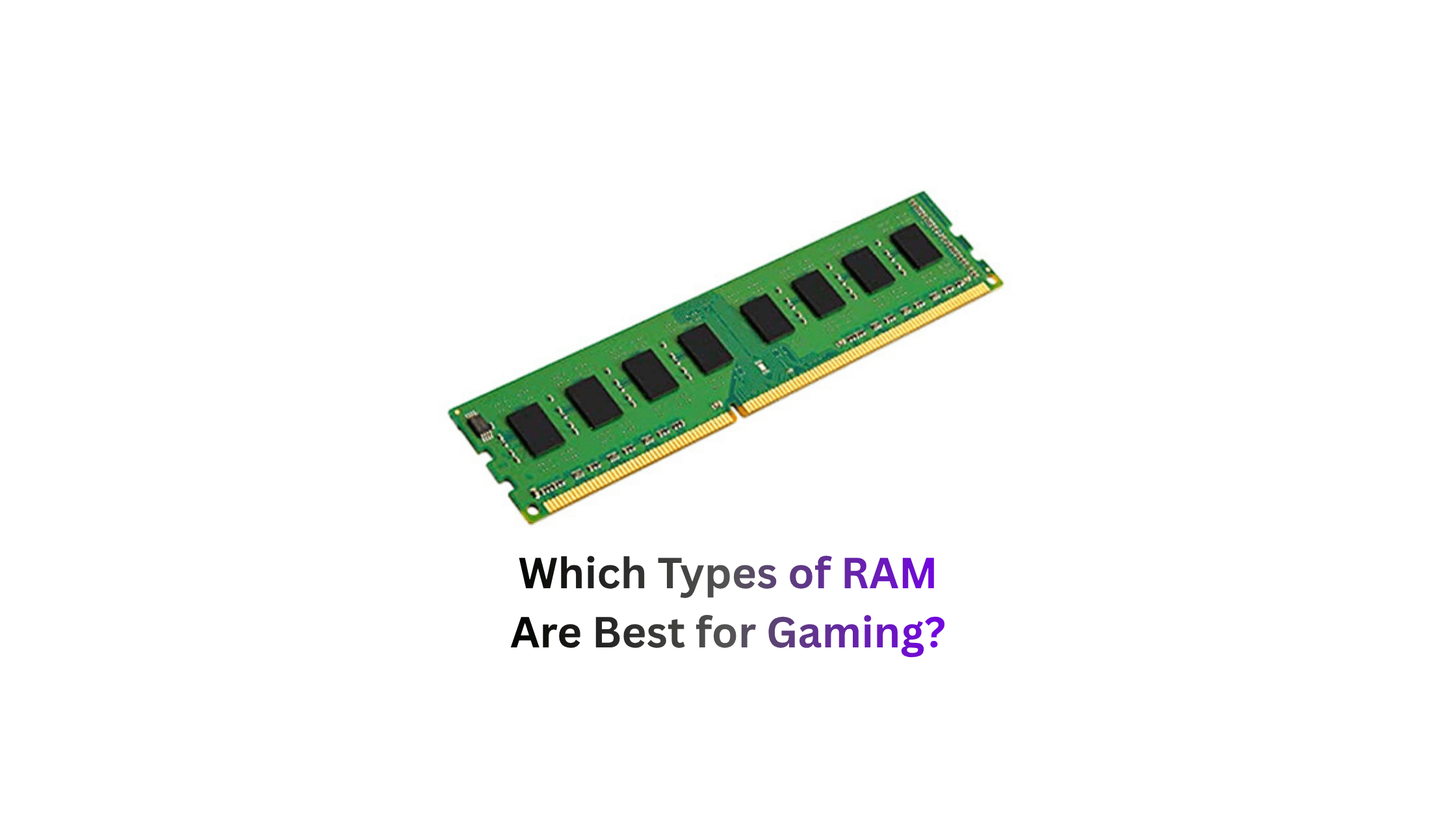
    Which Types of RAM Are Best for Gaming?

    RAM is one of those components that most people buy once and never think about again. But in 2026, the wrong RAM choice can cost you real performance and the right choice depends entirely on your platform, budget, and what you’re gaming on. Here’s everything you need to know, broken down clearly.

    First: Understand the RAM Types That Actually Affect Gaming

    Not all RAM is the same and different types serve completely different purposes. Before picking a kit, you need to know which type is relevant to your specific device.

    Here’s the full breakdown:

    RAM TypeUsed InWhat It Does
    DDR4Desktop PCs, older laptopsGeneral-purpose system RAM, AM4 and LGA 1700 platforms
    DDR5Modern desktop PCs, new laptopsCurrent-gen standard, AM5 and Intel 12th gen onwards
    LPDDR5Laptops, phones, tabletsLow-power DDR5 for mobile devices, soldered in place
    LPDDR5XUltrabooks, handhelds, flagship phonesFaster version of LPDDR5, better for AAA mobile gaming
    GDDR6/GDDR6XGPU VRAMGraphics card memory, not upgradeable by user
    GDDR7Latest GPUs (RTX 5000, RX 9000)Next-gen GPU VRAM, 2x bandwidth of GDDR6
    HBM3/HBM4AI chips, server GPUsUltra-high bandwidth, not relevant to consumer gaming

    The types that matter for most gamers are DDR4, DDR5, and LPDDR5. Everything else is either inside your GPU or inside your phone.

    DDR4: Still Alive and Genuinely Good

    DDR4 is not dead in 2026 and if you’re on an AM4 or LGA 1700 platform, it still makes a strong case. DDR4 was the de facto memory standard for PCs for the last decade and still performs very well in gaming. Real-world benchmarks consistently show DDR4 running at 3200 to 3600 MHz coming within 5% of budget DDR5 in most gaming workloads.

    Testing shows that a 32GB DDR4-3200 or 3600 MHz kit performs within 5% of entry-level DDR5 in most games.

    At 1440p and 4K the gap shrinks even further because the GPU becomes the main bottleneck anyway. The real-world performance differences are small and non-existent in GPU-limited scenarios such as 4K gaming, which is usually the case unless you’re chasing very high frames per second.

    The sweet spot for DDR4 gaming in 2026:

    On Intel platforms, 3200 MHz with CL16 timing gives strong, stable performance on most boards. On AMD Ryzen, 3600 MHz is the better target because it aligns the Infinity Fabric at 1800 MHz, which lowers latency and improves 1% lows in CPU-sensitive games.

    Should you upgrade from DDR4 to DDR5? If you have a good DDR4 kit, let’s say a 2×16 GB DDR4-3200 C14 kit or better, there’s little reason to spend the money to upgrade to DDR5 for gaming.

    DDR5: The Current Standard for New Builds

    If you’re building a new PC in 2026, DDR5 is the only sensible choice. It’s certainly sensible to opt for DDR5 when making a new purchase, especially as it’s also an investment in the future. New gaming titles with high demands will run significantly better on DDR5 than on DDR4, and the next upgrade to DDR6 won’t appear until 2027 at the earliest.

    DDR5 isn’t just faster it’s architecturally different. DDR5 supports larger memory capacity, higher bandwidth, and is more efficient. DDR5 is twice as fast as DDR4 and quadruples the per-die memory density. It also splits the larger 64-bit channel into two independent 32-bit subchannels.

    The performance gains are real at 1080p. At 1080p with a fast GPU and CPU-bound games, DDR5 can show 10-20% higher frame rates. For competitive gaming at high refresh rates, DDR5 6000 is the better choice.

    The Right DDR5 Speed for Your Platform

    This is where most people get it wrong buying the fastest DDR5 kit available isn’t always the best move. Your CPU’s memory controller has a sweet spot, and exceeding it gives you diminishing returns.

    Different processors need different memory configurations for optimal performance. DDR5 only sweet spot is 6000 MT/s CL30 for perfect 1:1 sync with memory controller on AMD. X3D chips need nothing faster. Arrow Lake benefits from 6400 to 8000 speeds. CUDIMM technology stabilizes extreme frequencies above 8000 MT/s.

    Here’s the platform-specific sweet spot table:

    PlatformBest DDR5 SpeedNotes
    AMD AM5 (Ryzen 7000/9000)DDR5-6000 CL30Perfect 1:1 Infinity Fabric sync
    AMD AM5 X3D chipsDDR5-6000Going faster adds no gaming benefit
    Intel Arrow Lake (Z890)DDR5-6400 to 8000CUDIMM helps above 8000 MT/s
    Intel Core 13th/14th GenDDR5-5600 to 6000Stable sweet spot
    Budget DDR5 buildsDDR5-5600Solid entry point, good value

    CUDIMM technology costs a significant premium and only benefits Intel Z890 boards running above 8000 MT/s. Most gamers see negligible real-world gains. Standard UDIMM DDR5-6400 offers 95 percent of the performance at half the cost.

    How Much RAM Do You Actually Need?

    The minimum bar has moved in 2026 and it moved faster than most people expected. Several 2024-2026 titles have reported performance issues with 16GB, and memory usage in open-world games is creeping up. 32GB DDR5 is the recommended baseline for a future-proof gaming PC, not overkill.

    We suggest starting with 16GB for DDR4 systems. For DDR5 systems, only use two sticks. At higher speeds, memory controllers don’t work well with 4-stick setups. If you can afford it, 32GB is the best amount.

    Here’s the honest capacity guide:

    RAM AmountWho It’s ForReality Check
    8GBAbsolute budget minimumStutters in modern open-world games
    16GB DDR4Budget gaming, older platformsHandles current games, tight on newer titles
    16GB DDR5Mid-range new buildsWorks fine today, may need upgrade by 2028
    32GB DDR4Existing DDR4 systems future-proofingBest value upgrade for older platforms
    32GB DDR5New builds, recommended baselineThe default recommendation for 2026 builds
    64GB DDR5Content creators, streaming while gamingOverkill for pure gaming but useful for multitaskers

    LPDDR5 and LPDDR5X: For Laptop and Mobile Gamers

    If you game on a laptop, ultrabook, or handheld, LPDDR5 is your RAM type and you cannot upgrade it. LPDDR is a low-power version of DDR RAM, designed for energy efficiency. It’s used in devices where battery life is a priority. LPDDR5 is soldered directly onto the motherboard you choose your capacity when you buy the device, and that’s it forever.

    LPDDR5X is the version that actually matters for gaming laptops in 2026. With the introduction of LPDDR5X, bandwidth has reached or even surpassed that of DDR5, enabling smooth performance when running AAA games on devices like ultrabooks.

    The trade-off is thermal limits. Sustained heavy gaming on LPDDR5X devices runs into the thermal ceiling of the chassis faster than a desktop DDR5 system which is why gaming laptops with LPDDR5X still throttle under extended load in ways desktop builds don’t.

    GDDR7: The GPU VRAM Revolution

    Your GPU has its own separate RAM and in 2026, GDDR7 is the new standard on RTX 5000 and RX 9000 cards. GDDR (Graphics Double Data Rate) memory is similar to DDR RAM but optimized for graphical workloads. Current GPUs use GDDR6 or GDDR6X.

    GDDR7 doubles the bandwidth of GDDR6 which is critical for 4K gaming where texture streaming from VRAM is the bottleneck. If your GPU runs out of VRAM, textures spill over into system RAM, and the bandwidth difference between GDDR7 and DDR5 creates a massive performance gap.

    This is why VRAM capacity matters alongside system RAM. A GPU with 12GB of GDDR7 is significantly faster than one with 12GB of GDDR6 even at the same capacity.

    What’s Coming Next: DDR6

    DDR6 is on the horizon but not worth waiting for. Desktop DDR6 won’t arrive before late 2027 or early 2028. Waiting means losing 1-2 years of performance. New standards come with high prices at launch, initial BIOS bugs, limited compatibility, and low stock. Current DDR5 remains very performant for 3-5 years minimum.

    The one exception is mobile. For laptops and mobile: if renewing late 2026, targeting LPDDR6 may make sense. The first LPDDR6 smartphones and laptops are expected in Q3/Q4 2026.

    Quick Verdict: Which RAM is Best for Your Situation?

    Your SituationBest RAM Choice
    New desktop build 202632GB DDR5-6000 CL30 (AMD) or DDR5-6400 (Intel)
    Existing AM4 or LGA 1700 system32GB DDR4-3600 CL16 no need to upgrade
    Budget new build16GB DDR5-5600 as a starting kit
    Gaming laptop buyerLook for LPDDR5X, minimum 16GB
    Competitive 1080p gamingDDR5-6000 the 10-20% FPS gains are real here
    4K gamingRAM generation barely matters, GPU is the bottleneck
    Should I wait for DDR6?No build now with DDR5, upgrade in 2028

    The honest bottom line for 2026: DDR5 is technically better, especially at high frequencies. In practice, the difference at 1440p and 4K is small under 5% in most games. Going 32GB DDR5-6000 is the default recommendation for any new gaming PC in 2026.

    If you already have DDR4 and it’s running at 3200-3600 MHz with 32GB stay there. Switching from DDR4 to DDR5 requires a new motherboard and usually a new CPU. The gaming performance gain does not justify that cost. If you are already planning a full build, yes, go DDR5. Otherwise, put the money toward your GPU.